
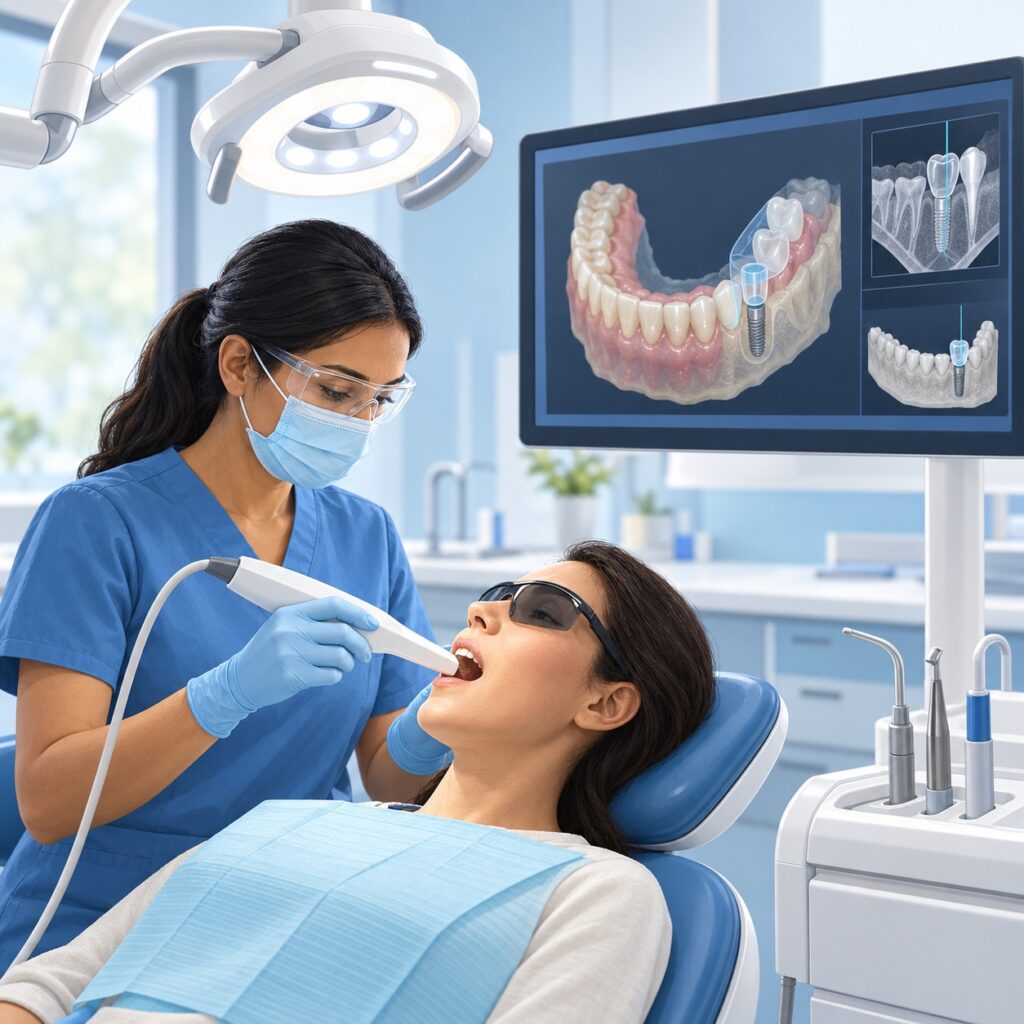
Dental technology can change how a dentist plans treatment, explains options or makes a restoration. What matters for you is whether a particular tool is useful for your treatment and what still needs a clinical assessment.
Smile Dental Center uses 3D dental scanning and guided implant surgery. The other technologies discussed below are examples from dentistry; their inclusion does not mean they are available at our clinic.
Smart dental chairs and monitoring
When a chair is described as “smart”, ask which features it actually has and why they are relevant to your appointment. Do not assume that the term means it monitors every aspect of your health or guarantees a more comfortable procedure. Tell the dentist about health conditions and any difficulty sitting or lying back.
Comfort is worth discussing in practical terms. Let the team know if you need help with positioning, have difficulty keeping your mouth open, or feel anxious about the visit. Agree on a signal for a pause before treatment begins. These conversations remain useful whether the chair has a screen, sensors or conventional controls.
If monitoring is proposed, ask what will be measured and how the information will be used during your appointment. A list of chair features tells you little about the care plan unless someone explains their purpose. You should also be able to ask for an explanation of images displayed on a chairside screen rather than being left to interpret them yourself.
AI in dental diagnosis and treatment planning
AI tools have different jobs. Design software is not the same as a diagnostic system, and a quick software result is not a completed treatment. For example, 3Shape Automate describes producing certain dental designs in as little as 90 seconds. The design still needs review and the restoration still needs manufacturing and clinical fitting.
If AI is involved in your care, ask what it is being used for and who checks the result. The Royal College of Dental Surgeons of Ontario guidance on AI says dentists must not rely solely on AI for clinical decisions.
A useful explanation separates the software’s suggestion from the dentist’s conclusion. For instance, a design tool can propose the shape of a restoration, while the dental team decides whether to accept or adjust it. Software processing time says nothing by itself about preparation, laboratory work, fitting or follow-up appointments.
If images or records are sent to an outside software service, you can ask how your information is handled. You do not need to understand the algorithm to ask what information it receives, what its output means and which professional takes responsibility for the treatment decision.
3D printing and chairside restorations
Scanning, digital design and manufacturing are separate steps. A clinic using a 3D scanner does not necessarily print or manufacture your restoration on site. Ask where the work will be made, which material is proposed and how many fitting appointments are expected.
Do not assume that a crown, aligner or implant treatment can be completed in one visit because 3D printing is mentioned. The proposed treatment plan should explain what can be provided at each appointment and whether any item is temporary.
The American Dental Association’s introduction to dental 3D printing gives diagnostic models, occlusal guards and surgical guides as examples of printed items. These have different purposes: a model can represent the mouth, while a surgical guide is used as part of a planned procedure. Printing a planning aid is different from completing the tooth replacement that a patient will use.
For a proposed restoration, the useful details are its intended use, material, expected appointments and how its fit will be checked. Ask whether an advertised same-day service applies to your particular case and whether laboratory stages are included in the quoted time. The clinic should explain the actual workflow before you arrange travel around it.
Augmented reality and virtual reality
If you are shown an augmented reality smile preview or offered a virtual reality experience, ask what it is intended to do. A visual preview should be discussed as an illustration of a proposal, with its limitations explained, rather than as a promise of your final appearance. You can also ask how to signal the dentist if you need a break while using a headset.
Augmented reality adds digital information to a view of the real world; virtual reality presents an immersive simulated environment. Neither term tells you how a particular dental product has been evaluated. When a tool is used to explain a treatment, ask which parts of the image represent your own records and which are a general illustration.
A preview can be a starting point for discussing what you like or dislike. It should leave room to talk about what can be achieved clinically, the alternatives and the reasons a final result could differ. If a headset is offered for distraction, you can ask to stop using it and continue communicating directly with the team.
Sterilisation and dental lasers
Infection control is a separate issue from whether a clinic uses a laser. CDC guidance for dental settings describes cleaning and processing instruments, sterilisation monitoring and following manufacturers’ instructions. A claim about UV light or an automated chair should not be taken as evidence that these requirements have been met.
If a laser is proposed, ask which procedure it will be used for, what alternatives are available and what risks or recovery instructions apply. A technology label alone cannot establish that a treatment will be painless or that recovery will be faster.
Cleaning and sterilisation have different roles in instrument processing. The CDC guidance above describes a sequence of steps and checks; the process cannot be judged from the appearance of equipment alone. Patients can ask how reusable instruments are processed and how the clinic checks that the process is working.
For a laser procedure, ask for the name of the treatment itself as well as the device. What is the dentist trying to treat? Why is this approach being considered for your case? An explanation should cover the expected course of care and relevant alternatives, without relying on phrases such as “advanced laser treatment” as the reason to proceed.
Teledentistry and remote monitoring
Remote contact can help patients discuss concerns and receive guidance, but some questions require an examination in person. US Department of Health and Human Services guidance on dental telehealth explains how virtual contact can help a dentist decide when an in-person visit is needed.
Before relying on a remote follow-up, confirm what the clinic offers, how to send information and what to do if a problem cannot be assessed remotely. Do not delay arranging an examination simply because a photograph or message has been sent.
For a remote conversation, prepare a short account of your concern, when it started and any treatment already received. Ask the clinic which records or photographs it needs and which channel to use. Keep a copy of the advice and any agreed next step so that a message exchange does not leave the plan unclear.
Travelling patients should discuss follow-up arrangements before leaving. Find out which appointments must take place in person, what remote contact can reasonably cover and who to see locally if an examination is needed. A remote service is most useful when its limits and the route to an in-person appointment are clear.
Discussing technology at Smile Dental Center
For our 3D dental scanning and guided implant surgery, ask the treating dentist how these will be used in your particular plan. You can read about dental implant treatment or call 083 066 9486 to arrange a consultation. Bring your questions about appointments, costs and follow-up care.
With guided implant surgery, a surgical template can help the dentist carry out the planned procedure, as described in Nobel Biocare’s explanation of surgical templates. This source explains the general concept; it does not identify the brand used by our clinic. Your dentist should explain which records are needed and which steps in your plan will use a guide.
At your consultation, ask to see how the plan relates to the concern that brought you in. If there are several reasonable options, discuss the appointments, aftercare and total estimated cost of each. Choose with an understanding of the proposed treatment, rather than the number of technologies listed on a website.